Getting Buy-In: How to Build the Case for AI in Your Office

This is Lesson 4 of The Student Accounts AI Field Guide Series, a companion learning series alongside our 2026 State of AI in Student Accounts report.
After reading our first three AI lessons, you know how to write a prompt that gets you something useful. You've started using AI to clean up a spreadsheet instead of losing an afternoon to it. And you have a framework for thinking through FERPA instead of a blanket "we can't." You are, in other words, more AI-fluent than you were three lessons ago.
And there's a good chance almost none of it is official.
That's not a guess. It's the most consistent finding in Meadow's 2026 research:
.png)
You've been building a skill in private that your institution hasn't caught up to yet.
This lesson is about closing that gap, not by waiting for permission, but by knowing how to ask for it in a way that actually works.
The gap has a name: Shadow AI
Meadow's research calls this the Shadow AI opportunity, and it's worth sitting with its shape. Among daily personal AI users, almost 100% carry that habit to work. The institutional barrier doesn't stop them. But among weekly personal users, people with real AI fluency, 16% pull back significantly at work. The gap isn't about skepticism. When we asked respondents why their work AI use lagged their personal use, nobody said AI doesn't work or isn't useful. They pointed to unclear institutional policy, FERPA and data privacy concerns, a lack of purpose-built tools, and simply not having a workflow where AI's value was obvious. Friction, not doubt, is the story.
That's good news, actually. Skepticism is hard to fix. Friction is fixable.
But shadow AI use is also fragile. When adoption happens quietly, one person at a time, with no institutional visibility, you get inconsistent practices, no shared knowledge of what's working, and, most importantly for this series, no one asking the FERPA and governance questions Lesson 3 walked through. The staff already using AI well are running that risk alone. Making that work visible and sanctioned isn't just good for morale. It's the fastest way to reduce exposure, because visible use is use someone can actually govern. If an institution doesn’t know how people are using AI; it can’t ensure that usage is safe.
Why leadership hasn't moved yet
If you've been waiting for a signal from above before you say anything about the AI work you're already doing, you may be waiting a while. 63% of respondents report no leadership pressure at all to adopt or plan for AI. 44% say AI is never discussed in their team meetings. Only 10% say student accounts leadership is the primary decision-maker for AI in their work. The rest is happening in a vacuum, or someone genuinely doesn't know who owns the question.
.png)
It's tempting to read that as leadership dragging its feet. The more useful read is that leadership isn't withholding permission but rather is waiting for a reason to pay attention. Institutions building real momentum aren't necessarily the best-resourced ones. They are the ones who are learning from their teams about how AI can be essential in improving work flows.
"It starts at the top. Michael Crow has been transforming this institution from what was literally the number one party school to the number one innovation school for over 23 years, and he's done it by hiring people who can push through every impediment. The scientific method says only one in ten experiments succeed — most fail. And yet you can't be afraid of that failure. Change the variable, try again."
Michael Latsko, CHRO, Arizona State University
ASU didn't wait for a top-down mandate to build a culture of experimentation; they built the culture, and the mandate followed. Your version of that doesn't require an enterprise OpenAI agreement. It requires one person willing to show a working example.
A four-move playbook for building the case
Meadow's research surfaced seven recommendations for moving AI from individual habit to institutional practice. Four of them are specifically about getting buy-in. We recommend leading with these if you're the person trying to move this forward at your institution.
.png)
1. Find your AI spark and bring it to the team: In virtually every student accounts office, someone is already experimenting quietly: testing things on their own time, sharing a discovery with one trusted colleague, but saying nothing to leadership. At your next team meeting, try asking: "What's the most interesting use of AI you've seen or tried lately?" The people who lean forward, who have a specific answer, who've been waiting for exactly this conversation, are your early adopters.
2. Reframe the ask. How you open the conversation determines whether it goes anywhere. Asking staff to name their "boring or repetitive work" puts job security and dignity on the table, and can shut the conversation down before it starts. Try a different entry point instead: "If we had new resources available, what would you hand off to them?" The same work surfaces without the threat. In practice, the people who felt most resistant to the first framing often become the most engaged with the second.
3. Start with the lowest-risk, highest-volume use case. For most student accounts offices, that's drafting responses to student inquiries and is the same use case Lesson 1 walked through. It's high-volume, it's repetitive, and a human reviews the output before it ever reaches a student, which keeps the risk low of an unreviewed error. One practitioner in Meadow's research cut drafting time from eight minutes per email to under two. Multiply that by your inbox volume, and you have a concrete number to bring to a leadership conversation and not an abstract case for "AI."
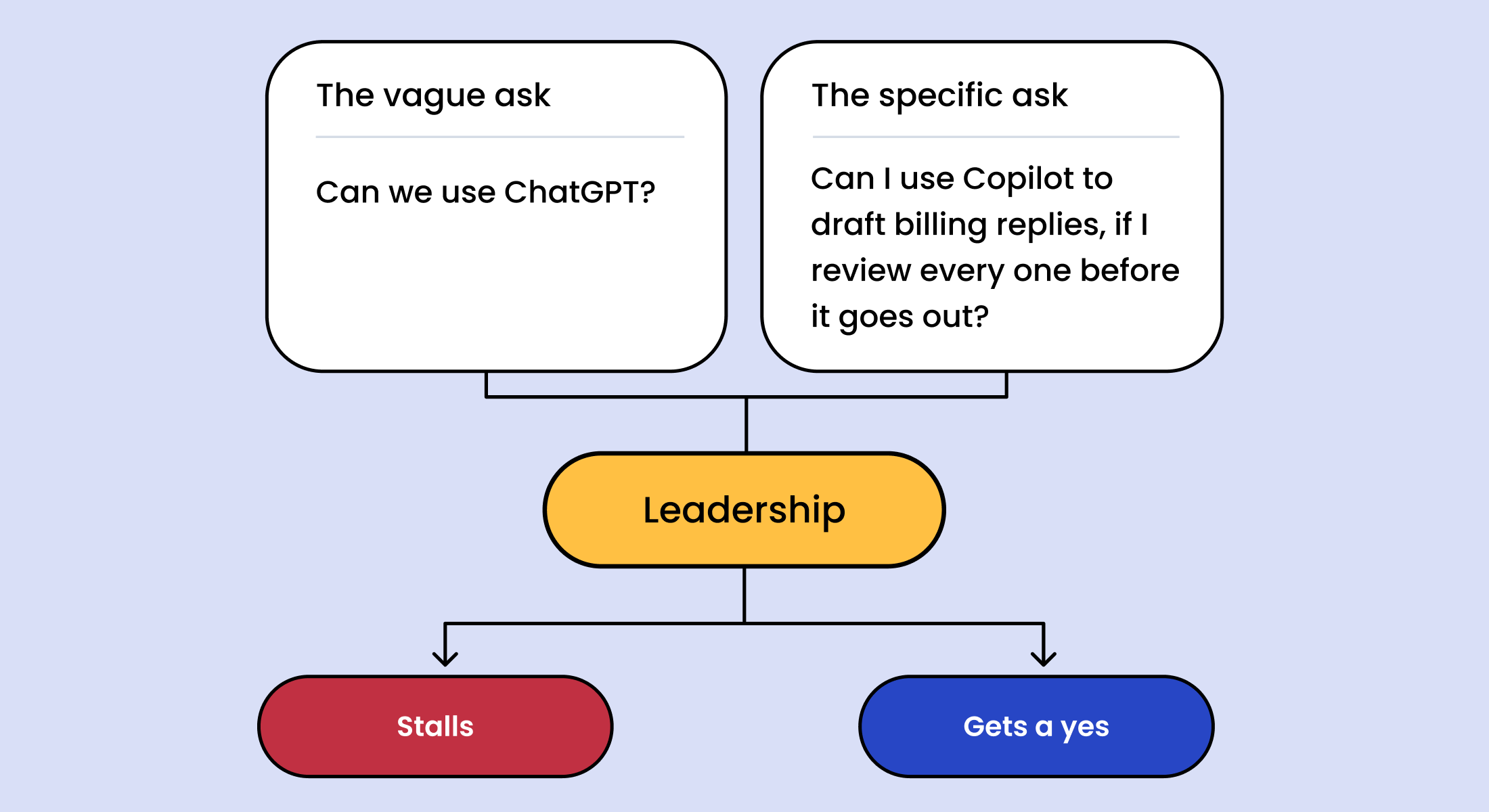
4. Get the governance question answered, even imperfectly. You cannot wait for a finished institutional AI policy before you engage, as the field is moving faster than most policy cycles. Push for a working answer to a specific, narrow question instead: "Can I use [specific tool] to draft [specific type of communication], if I review and approve all output before it goes to a student?" Most compliance teams, when asked something that concrete, can answer faster than you'd expect. It's the vague version of the question "can we use AI?" that stalls.
The other three recommendations including using the AI capability you've likely already paid for through your existing Microsoft, Salesforce, Workday, or Slate contracts; documenting and sharing what you try, even informally; and measuring and communicating early wins instead of waiting for a full ROI study, are worth their own conversation. But the four above are where a buy-in conversation will start and get traction.
Two myths worth retiring before you start
"We need a big IT project to get started." Many of the most effective early use cases, such as drafting inquiry responses, looking up policy, summarizing federal guidance, and building communication templates, require no system integration, no technical team, and no new budget line. Across the offices in Meadow's research that made meaningful early progress, the common thread wasn't technical infrastructure. It was a willing staff member and a specific problem worth solving.
"Our institution is too small to do this." Some of the most creative applications in Meadow's research came from small institutions with cultures that celebrate experimentation. Enrollment size didn't predict who was experimenting; motivation, culture, and permission did.
"The hesitation in functions like student accounts isn't just general AI skepticism — there's something particular about touching financial data. The trust bar is higher there. But trust gets built the same way it did in admissions: through visible results that people can see and verify for themselves."
Justin May, Chief Enrollment Management Officer, Richard Bland College
What to bring into the room
When you're ready to have the actual conversation with a manager, director, VP, or compliance partner, come with specifics, not a general pitch:
- The use case. Name the exact task, not "AI" as a category (e.g., "drafting first responses to billing inquiries.")
- The tool. Name what you'd use, and whether it's something the institution already has a license for.
- The review step. Be explicit that a human checks every output before it reaches a student. This is usually the detail that moves a hesitant compliance partner.
- The number. However rough, bring a before/after estimate, such as minutes per email, inquiries per week, whatever you can measure. A director who can say "our average response time is down 30% since March" is making a budget case and a cultural case at the same time.
- The boundary. Say plainly what data will and won't touch the tool, and point to the framework from Lesson 3 if the FERPA question comes up.
That's a fundamentally different conversation than "Can we use ChatGPT?" It's more work up front. It's also the version of the conversation that actually gets a yes.
One honest note on caution
None of this is a case for moving recklessly. The caution student accounts professionals feel is well-placed; it comes from working with some of the most sensitive data an institution holds, not from job-security fear. Job reductions ranked near the bottom of concerns in Meadow's research, cited by only 9% of respondents. What staff are actually afraid of is making a mistake with student data. That's a productive and protective instinct. The goal of this lesson is to encourage you to bring real-world examples of how AI can support your work and open conversations about what can work safely and effectively,
Once your office knows where the lines are and has a specific, reviewed use case to point to, you're no longer asking permission in the abstract. You're asking your institution to formally back work you've already proven out. That's a much easier yes.
This is Lesson 4 of The Student Accounts AI Field Guide Series, a companion learning series alongside Meadow's State of AI in Student Accounts report. Each lesson covers a practical topic grounded in data from the field.
Meadow's research for this series is drawn from The State of AI in Student Accounts, based on a March 2026 survey of 147 professionals across student accounts, billing, finance, collections, and One Stop/shared services.
